A Gentle Introduction to Program Analysis
Before diving into OCaml exercises, let's build intuition for what program analysis does,why it matters, and the fundamental tradeoffs every analyzer faces. No coding required — just reading, clicking, and thinking.
Why Program Analysis Matters
On June 4, 1996, the European Space Agency's Ariane 5 rocket exploded 37 seconds after launch. The cause? A software bug that program analysis could have caught.
Timeline of Failure
Liftoff. Inertial Reference System (IRS) running guidance software reused from Ariane 4.
Software converts 64-bit float (horizontal velocity) to 16-bit signed integer. Ariane 5 is faster than Ariane 4 — the value exceeds 32,767.
Integer overflow triggers an Ada exception. The backup IRS — running identical code — also crashes.
Flight computer interprets diagnostic data as navigation data, makes a hard turn. Aerodynamic forces tear the rocket apart. Self-destruct activates.
The Actual Bug (Ada Code)
-- Horizontal velocity: ~32,768+ on Ariane 5
-- (was always < 32,767 on Ariane 4)
L_M_BV_32 := TBD.T_ENTIER_16S(BV_Calc_Horiz);
--           ^^^^^^^^^^^^^^^^^
-- Converts 64-bit float to 16-bit signed integer
-- Max value: 32,767 → OVERFLOW!
The conversion had no range check. On Ariane 4, the value was always small enough. On Ariane 5's faster trajectory, it wasn't.
What Program Analysis Would Have Caught
- ✓Abstract interpretation (interval analysis) would track that
BV_Calc_Horizcan exceed 32,767 given Ariane 5's parameters - ✓Type range analysis would flag the unchecked 64→16 bit narrowing conversion
- ✓Astree (a real static analyzer) was later applied to Ariane code and found this exact class of bug automatically
Cost of the bug: $370 million in destroyed rocket + payload. Cost of static analysis: a few hours of compute time.
Your First Static Analysis
Let's walk through how a static analyzer would examine this simple function — step by step, without ever running it.
1function divide(a, b) {2if (b > 0) {3return a / b; // Safe: b is guaranteed > 04} else {5return a / b; // BUG: b could be 0!6}7}89// These calls exist in the program:10divide(10, 5); // OK: b=5 > 0, takes true branch11divide(10, 0); // BUG: b=0 <= 0, takes false branch → 10/0!12divide(10, -3); // OK: b=-3 <= 0, takes false branch → 10/(-3)
Start: Read the function signature
We see `divide(a, b)` takes two parameters. We don't know their values yet — that's the point of static analysis. We reason about ALL possible inputs.
Your First Dynamic Analysis
Now let's analyze the same program dynamically — by actually running it with specific inputs and observing what happens.
1function divide(a, b) {✓2if (b > 0) {✓3return a / b;✓4} else {5return a / b;6}7}
a=10, b=5
2
b=5 > 0, so we take the true branch (line 3). The false branch (line 5) is never executed. No error — but we only tested one path!
The Fundamental Tradeoff
Every program analysis tool must choose where it sits on the soundness/completeness spectrum. Click each quadrant to learn more.
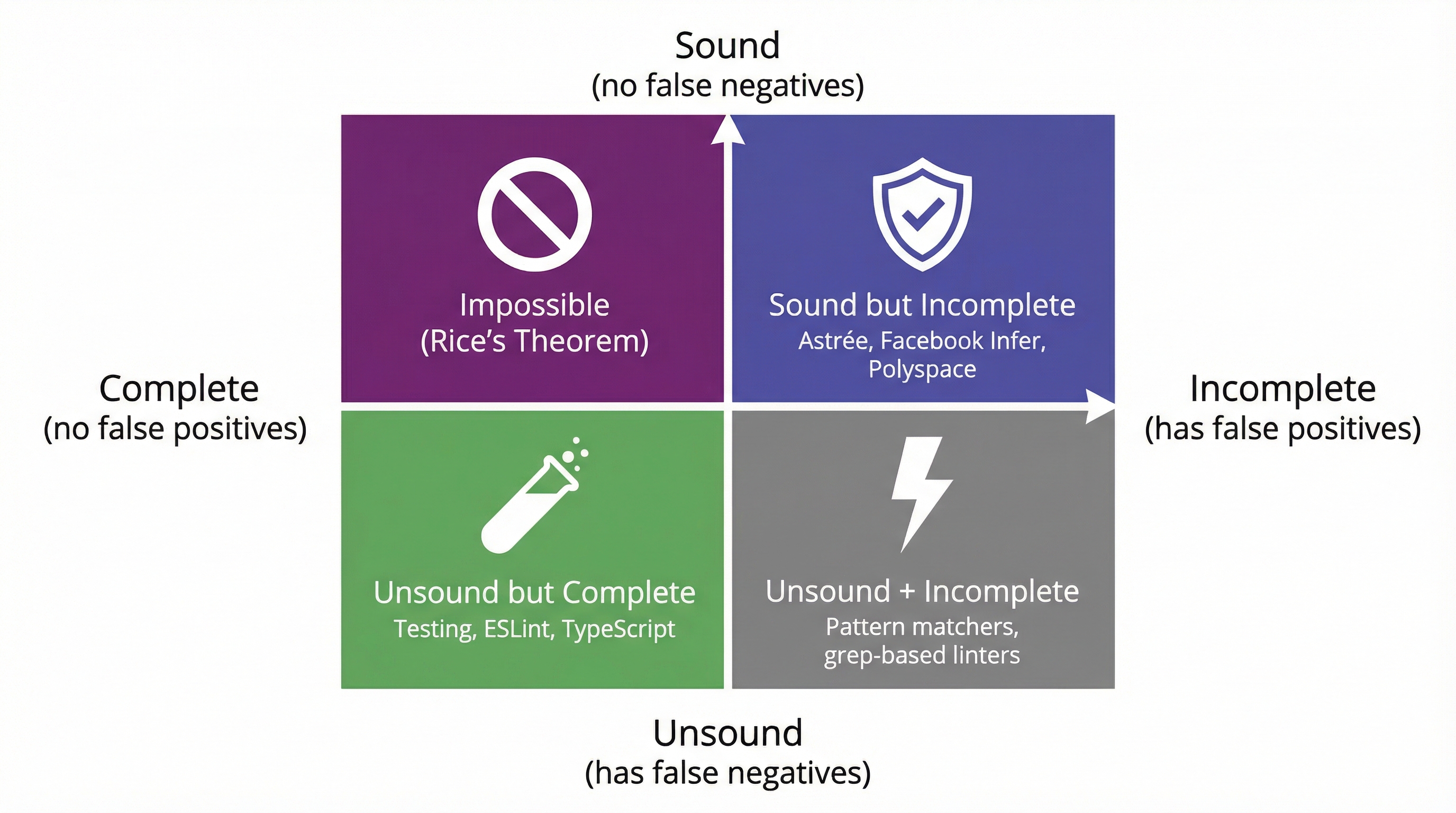
*Rice's theorem: For any non-trivial property of programs, no analyzer can be both sound and complete. This is a fundamental result in computability theory.
Real-World Tools
These tools use the concepts you're learning in this course. Here's what their output actually looks like.
ESLint
staticJavaScript linter — pattern-based static analysis. Fast, unsound, but catches common mistakes.
$ eslint app.js

  3:17  error    'password' is assigned a value but never used  no-unused-vars
  7:5   warning  Unexpected console statement                   no-console
  12:22 error    'getUserById' is not defined                   no-undef
  15:3  warning  'result' is already defined                    no-redeclare
  18:10 error    Expected '===' and instead saw '=='            eqeqeq

✖ 5 problems (3 errors, 2 warnings)
  2 errors and 1 warning potentially fixable with --fix
Ready to Try It Yourself?
You now understand the core ideas behind program analysis. Time to put them into practice.
Analysis Playground
Compare static vs dynamic analysis on 6 different code snippets. See findings, coverage, and Venn diagrams side by side.
Open playground →Exercise 1: Analysis Comparison
Your first hands-on exercise. Classify analysis techniques, identify tradeoffs, and reason about what different approaches can detect.
Start exercise →